





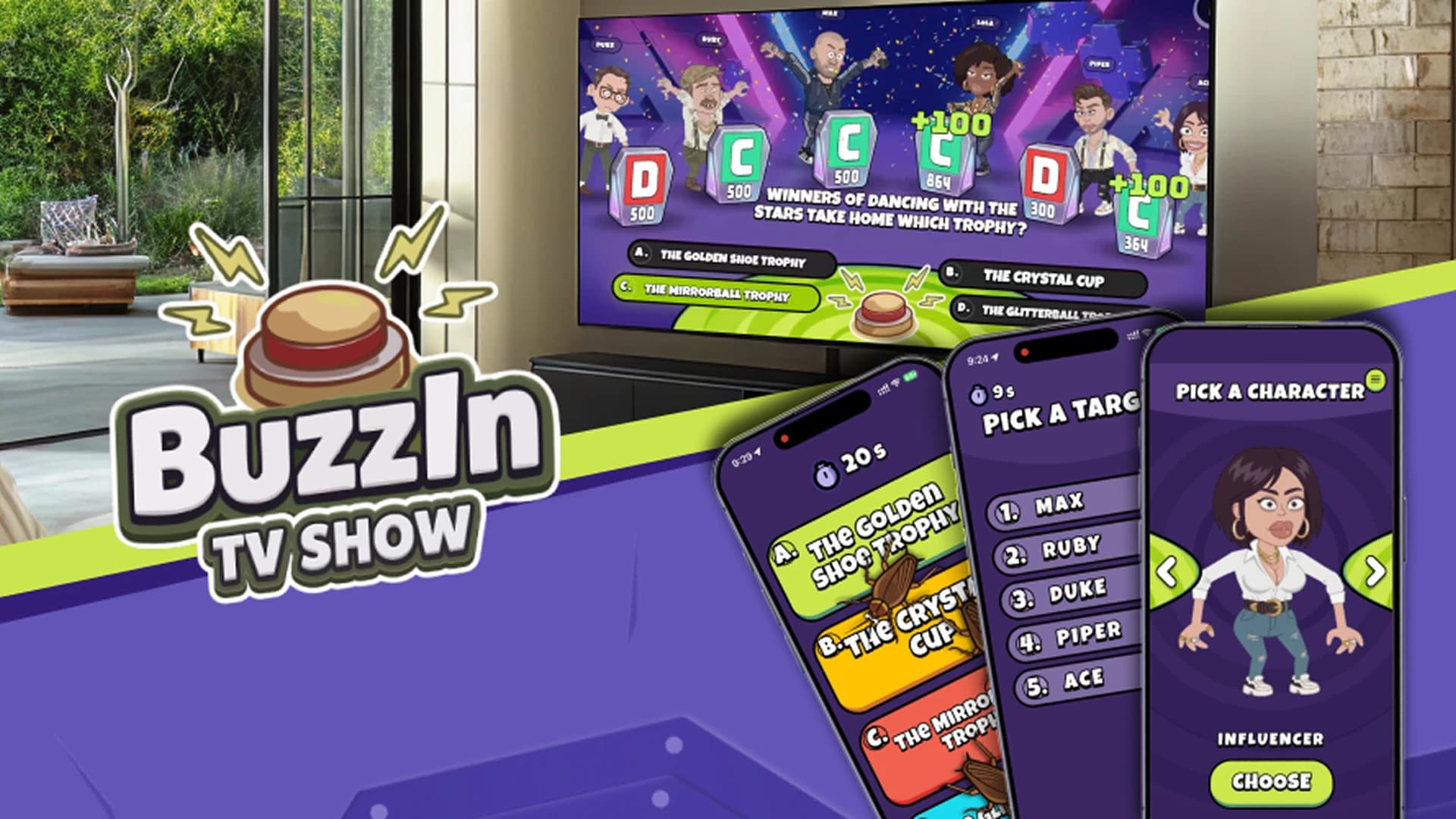
Client: Buzzin
A TV game show where phones are the buzzers
2 to 16 players, one screen, nothing to install. Codigee designed and built every surface of the platform. See the TV quiz game live.
0-00
players online
0000s
of players on day one
0
games coming soon
0
authored languages
How a player joins
Four steps, no install at any point, and a late guest can still walk in mid-round.
- 01
Open the show on the TV
Any browser on the big screen: smart TV, Chromecast or a laptop on HDMI.
- 02
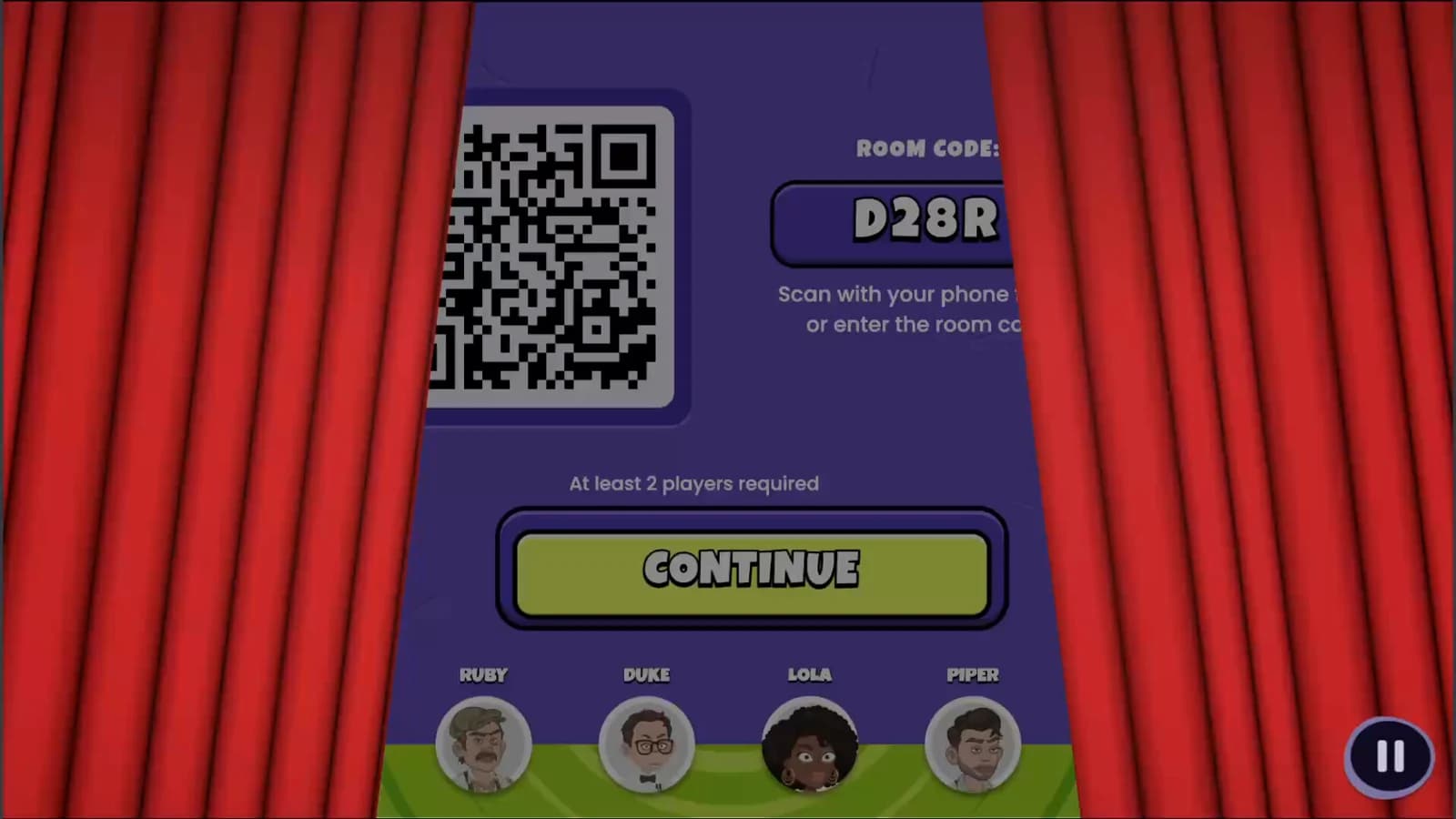
A room code appears
The TV shows a QR code and a four-letter code. Nothing is paired, nothing is downloaded.
- 03
Players scan it
Each guest opens the code on their own phone and picks a nickname. Up to 16 of them.
- 04
The phone is the buzzer
The show runs on the TV, the phone only answers. A late guest can still join mid-round.
A platform, not a single game
The host, the rooms and the controller are shared. A new title is a plugin, which is how the second one shipped without touching the first. Two are live today.
Quiz show
TV Show
The flagship title: a voiced host, category votes and tricks you drop on the player who is winning. party quiz show for your TV.
Social deduction
Werewolves: Prime Time Moon
The second title, shipped as a plugin on the same platform - different rules, same room, same phones. how the Werewolves party game is played.
The format
One TV, and every phone is a buzzer
A console gives you four controllers. Buzzin gives you sixteen players and nothing to install.
More+
The founders set out to build the game they missed: a living-room quiz in the spirit of Knowledge is Power (Wiedza to Potega in Poland), the PlayStation title where phones were the buzzers, but without the console and without the four-player ceiling. The show renders in the browser of the screen already in the room: a smart TV, a Chromecast, a laptop on HDMI. Players scan a QR code and their phone becomes a buzzer, so the room size is not capped by how many gamepads anyone owns. A fully voiced host reads the questions and keeps the pace. Codigee delivered every surface of it: design, TV renderer, mobile controller, realtime backend, content tools and the marketing site. The platform drew thousands of players from day one.
- Nothing to install
- No console, no gamepads, no app download for guests and no accounts to create. A QR code is the whole onboarding.
- A host that runs the night
- A voiced presenter reads questions, reacts to every move and keeps the pacing, so nobody in the room has to referee.
- Thousands of players on day one
- The platform went live to a real audience immediately, so the backend was built for a launch spike rather than for a demo.
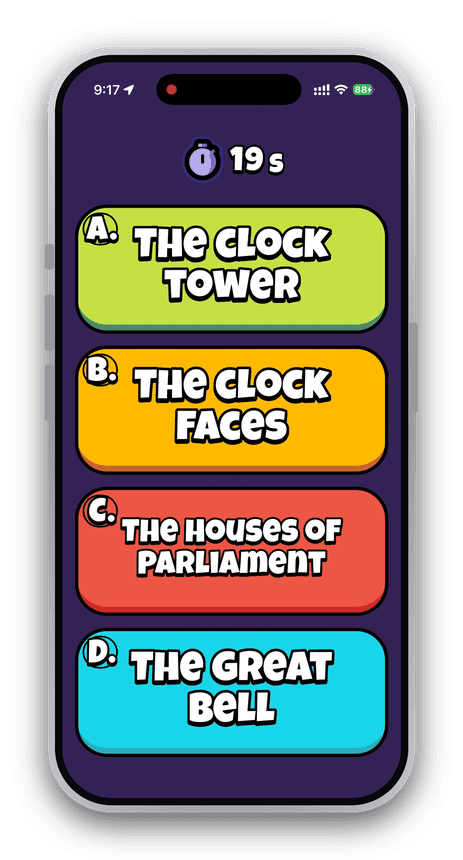
Design
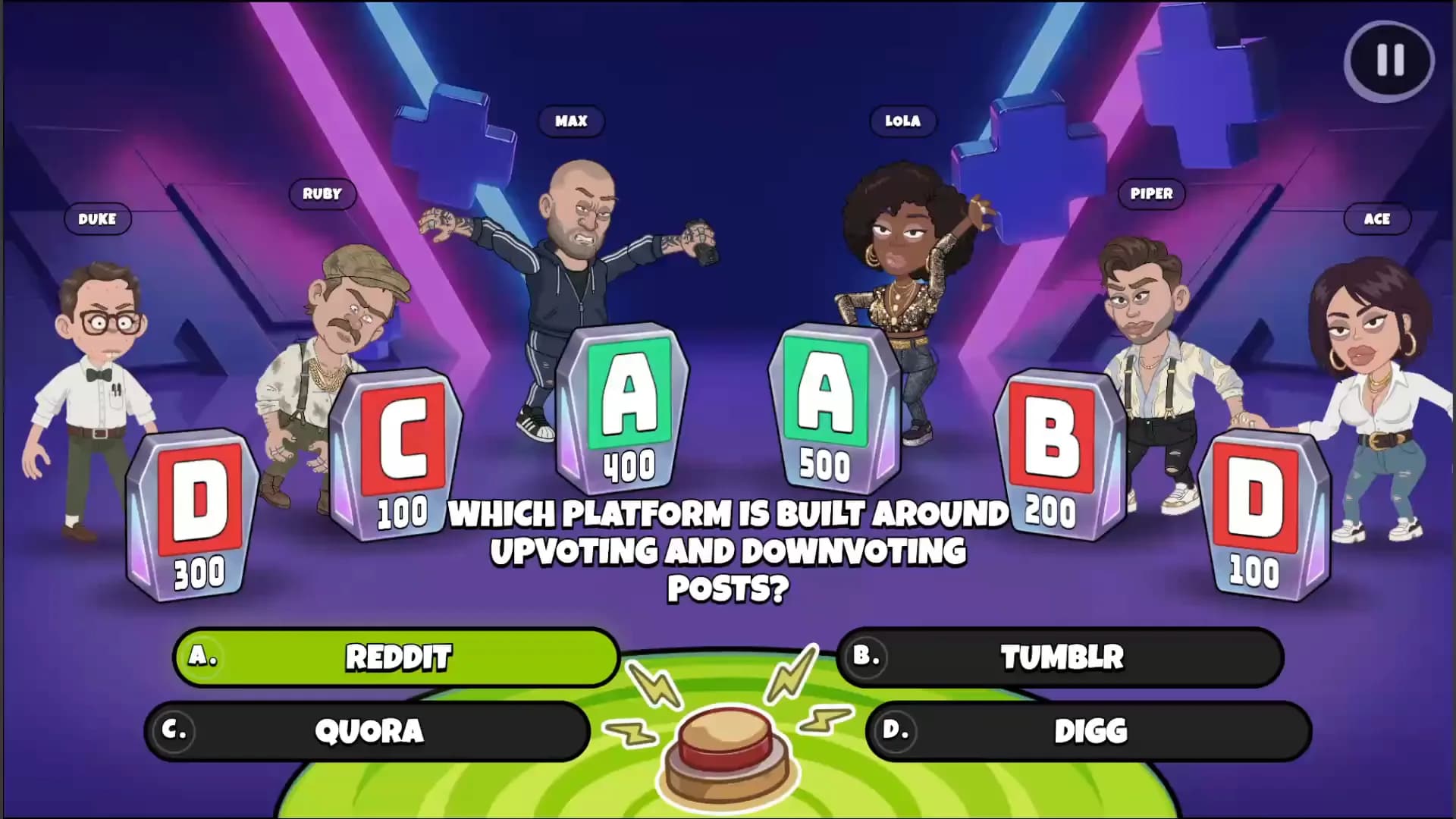
Design: it had to look like television
A quiz that looks like a web page feels like homework. Every frame was built to read as a broadcast.
More+
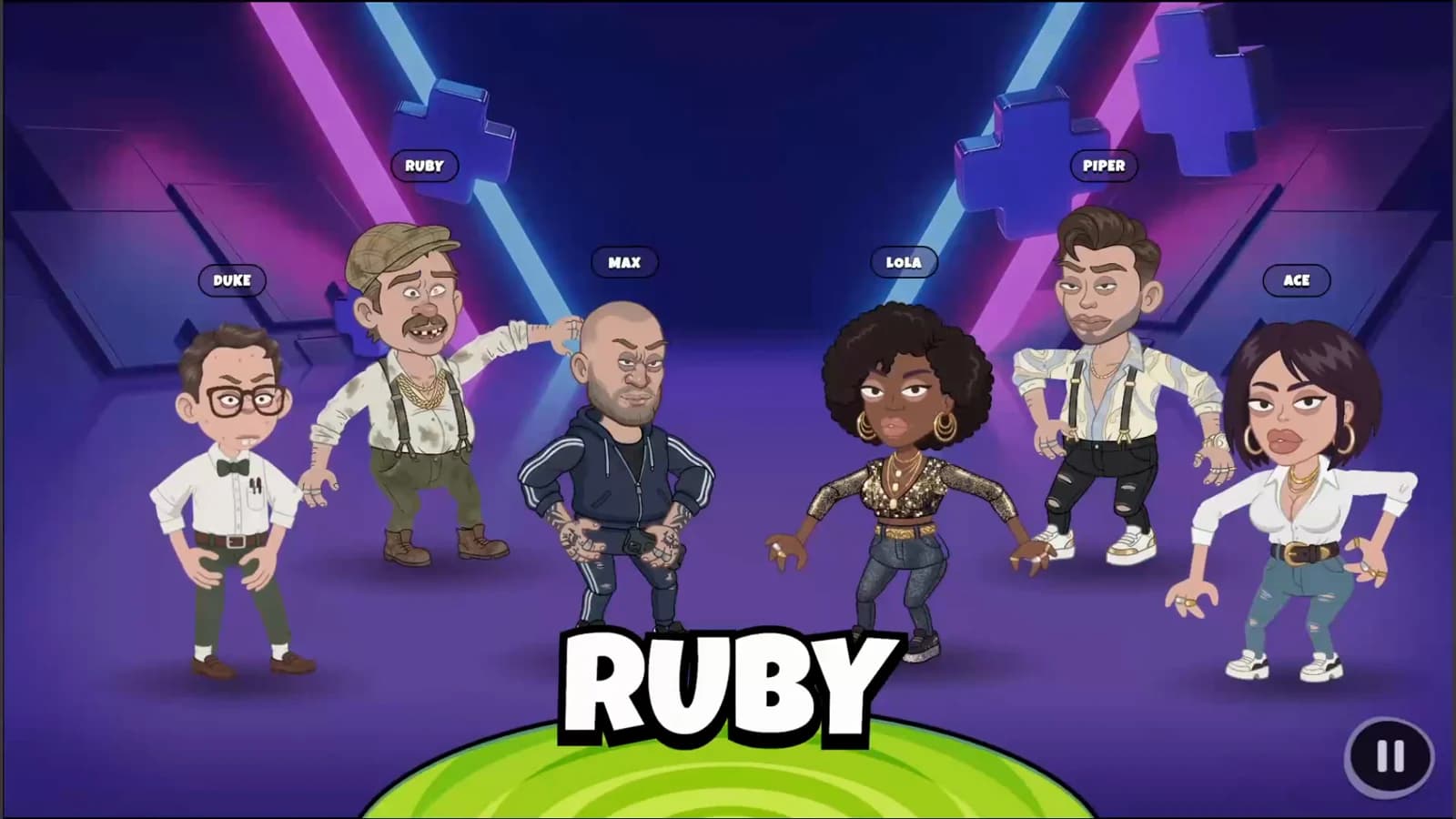
Everything is authored on a single 1920x1080 stage scaled by one transform, so an approved composition lands unchanged on a 55-inch TV and on a laptop. The cast is custom and rigged, animated by a bone engine we wrote, so a character reacts to the thing that just happened instead of playing a canned clip. Transitions follow a strict contract: cuts, splashes and cover scenes with defined boundaries, and every overlay element animates both in and out.














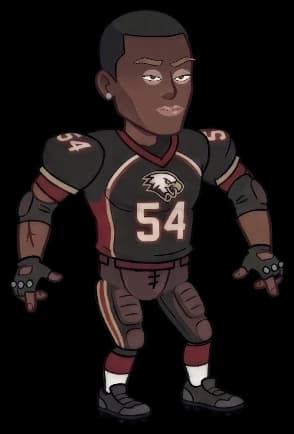
A rigged cast, not clip art
Fifteen characters, each one rigged and driven by game events through our own bone engine.
One 1920x1080 stage
A single design canvas scaled by one transform, so layouts survive every screen size.
Broadcast transitions
Curtains, splashes and cover scenes with defined boundaries, and every overlay element animates out as well as in. Nothing pops off screen.
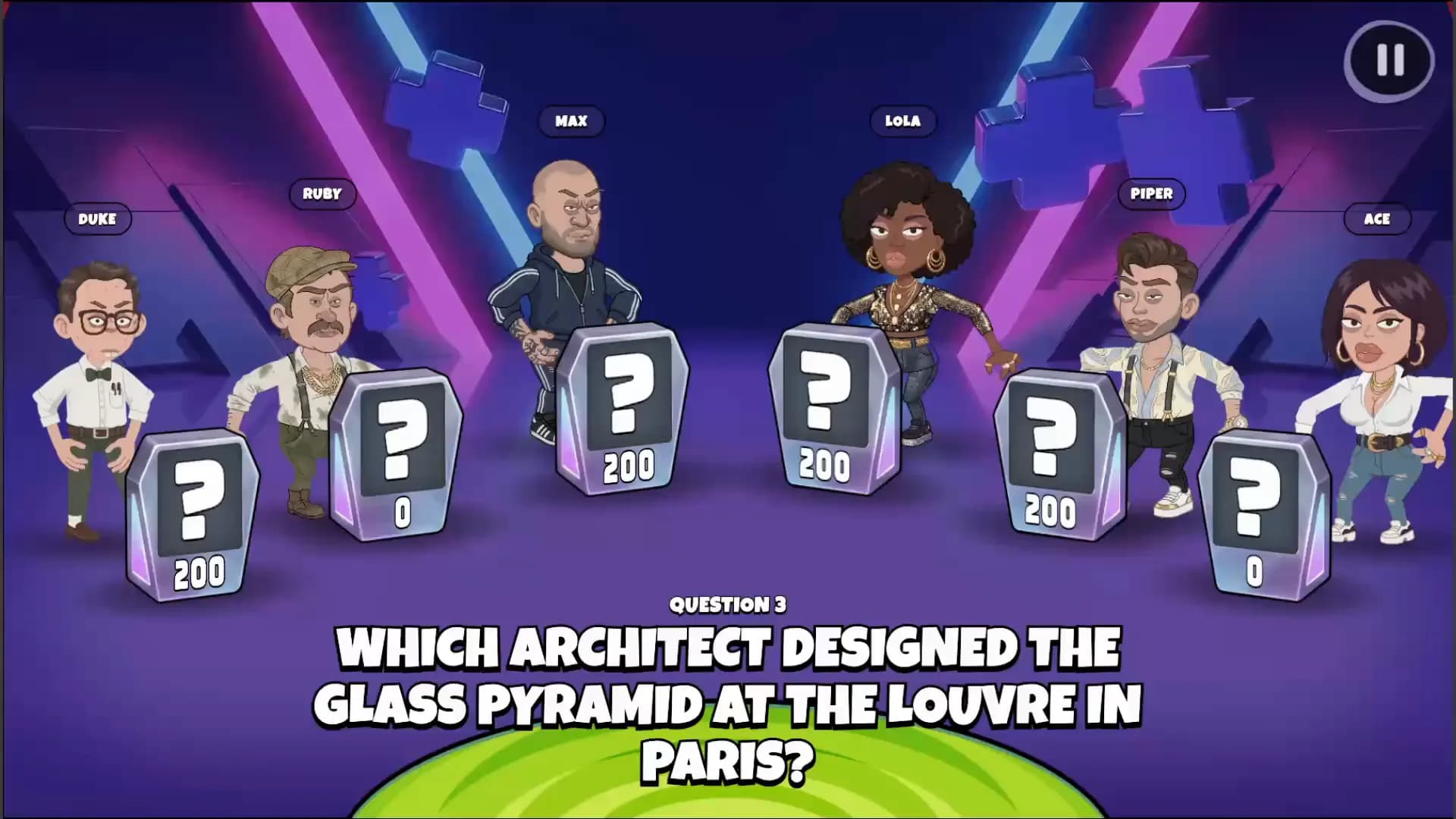
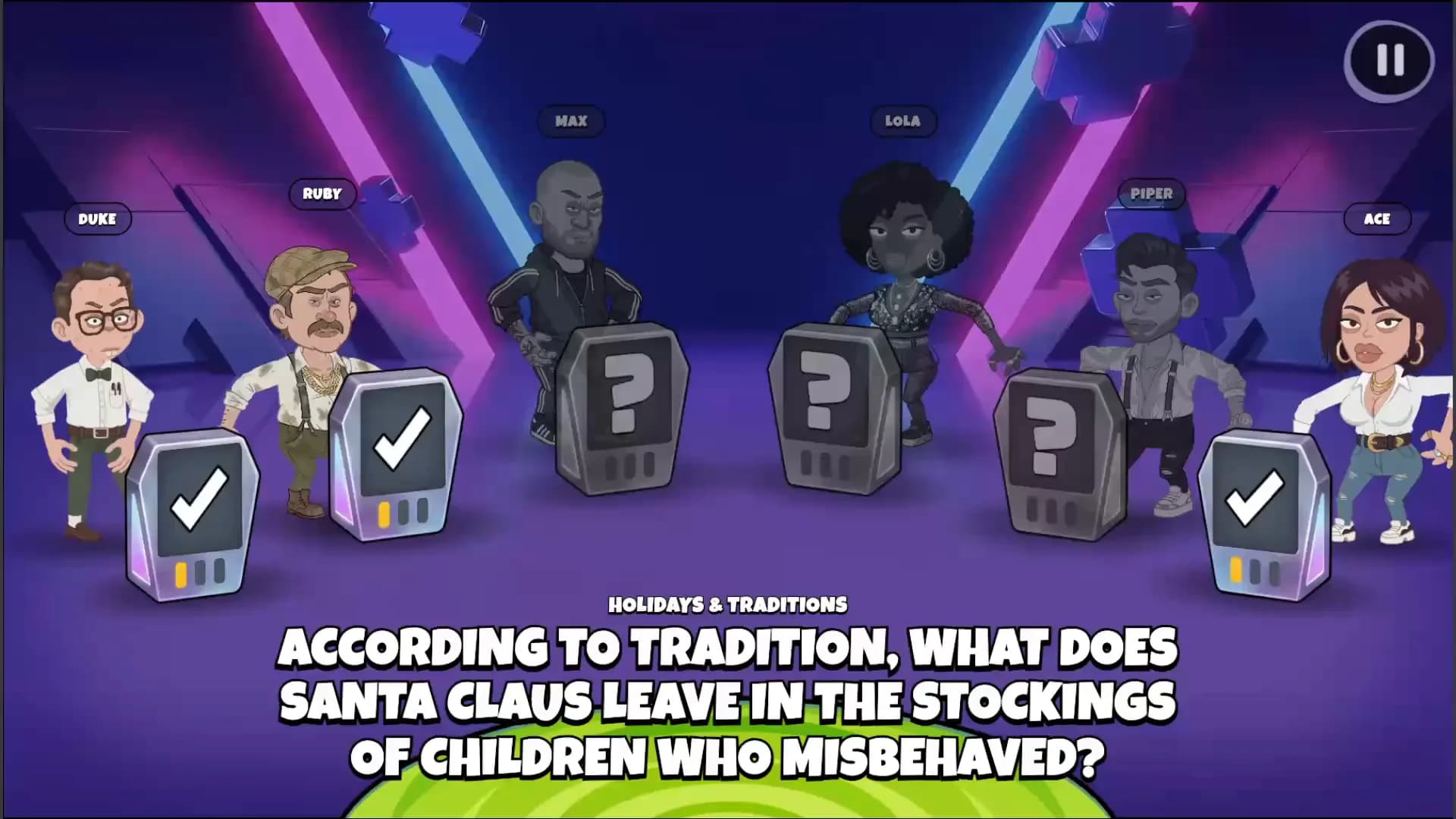
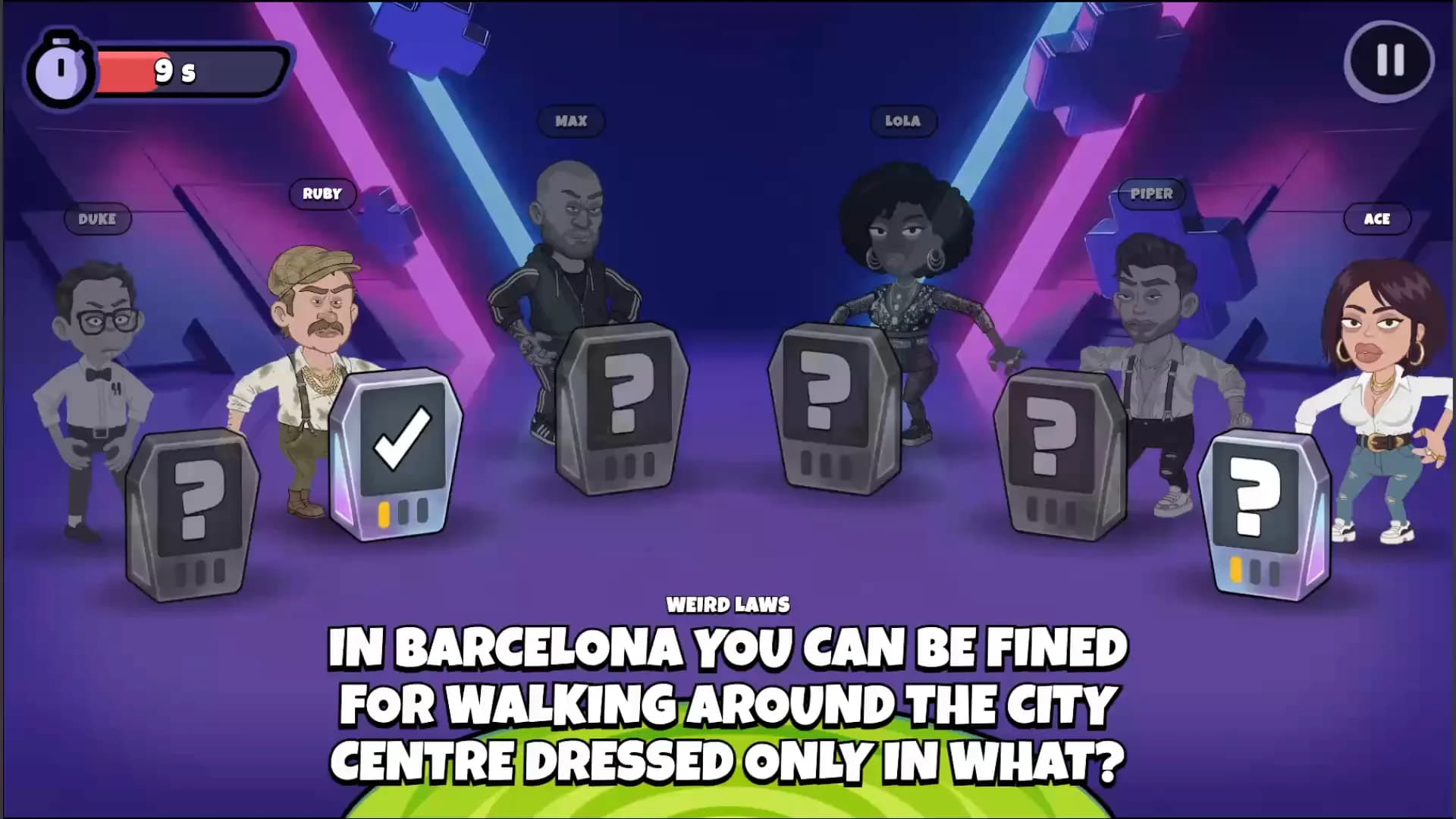
Scores resolved between questions
Scores resolved between questions
TV app
The TV app: a stage in a browser
Next.js rendering a PixiJS stage, built as a host plus plugins so a new show is a plugin, not a new product.
More+
A game-agnostic host owns the lobby, the room lifecycle and the transitions, while each show registers its own scenes. Scenes are deliberately dumb: they render server state and emit player actions, never mutate. Rendering live on TV hardware forced two hard rules - crowd scenes pool character rigs onto one shared WebGL context instead of one per character, and viewport units are banned and enforced by a build check, because they break the proportional stage.
- Host plus plugins
- A second title shipped without touching the platform the first one runs on.
- One shared WebGL stage
- Crowd scenes pool rigs onto a single context, which is what stops characters from blanking out.
- Design-space pixels only
- Viewport units are banned and enforced by a build check plus a runtime guard.
- Reconnect into the right scene
- The client derives its scene from server state, so a refreshed TV returns mid-round, not to the lobby.
Controller
The controller: Flutter, zero friction
Guests join from a phone browser. The Flutter app is for the people who host these evenings every week.
More+
The app mirrors the TV architecture: a controller host owns transport and session, each show contributes its own controller UI as a plugin, state runs through Cubits and models through code generation. The hard part of a party controller is the network, not the layout - phones lock, calls arrive, someone walks into the kitchen - so the controller rejoins the live room and rebuilds its screen from server state.
- On both stores
- One Flutter codebase shipping to the App Store and Google Play for the regular hosts.
- Reconnect is a feature
- Lock the phone, take a call, lose a bar: the controller rejoins the live room mid-round.
- Stable under the thumb
- The layout does not move when an answer is tapped. In a buzzer game a shifting button is a lost round.
Paint
The target's answers disappear under a paint spill.
Bugs
Insects crawl over the buttons while the clock runs.
Stun
The screen goes dark for a beat at the worst moment.
Freeze
The controller locks while everyone else answers.
Devices
It runs in the browser you already have
No console, no set-top box, nothing installed on the big screen. If it has a browser, it runs the show.
More+
The TV app is a web app, so it plays in the browser of Samsung, Philips and LG smart TVs, on Android TV boxes, through a Chromecast, on a laptop plugged in over HDMI, and in any modern desktop or mobile browser. That is what makes the format work at a real party: the host does not have to own the right hardware, and nobody is sent to a store page before the first round.
Samsung
Tizen browser
LG
webOS browser
Philips
Android TV
TV boxes
Android TV / Fire TV
Chromecast
cast from a laptop or phone
Laptop on HDMI
the setup that always works
Any modern browser
Desktop and mobile run the same build, so a rehearsal on a laptop is the same product as the living room.
Drivable from a remote
Spatial focus navigation, because plenty of these screens have a D-pad and no pointer at all.
Tooling
Sixteen players, one developer
A sixteen-player party game is impossible to test alone, so we built the tooling that makes it possible.
More+
Our simulator boots a real room and runs the TV next to a grid of emulated phones, each one joined through the same QR code a guest would scan. Controllers can be added, dropped and reconnected one by one, device presets match real phone viewports, and debug and performance overlays sit one click away. That is how a sixteen-player show gets regression-tested before a release without booking sixteen people.
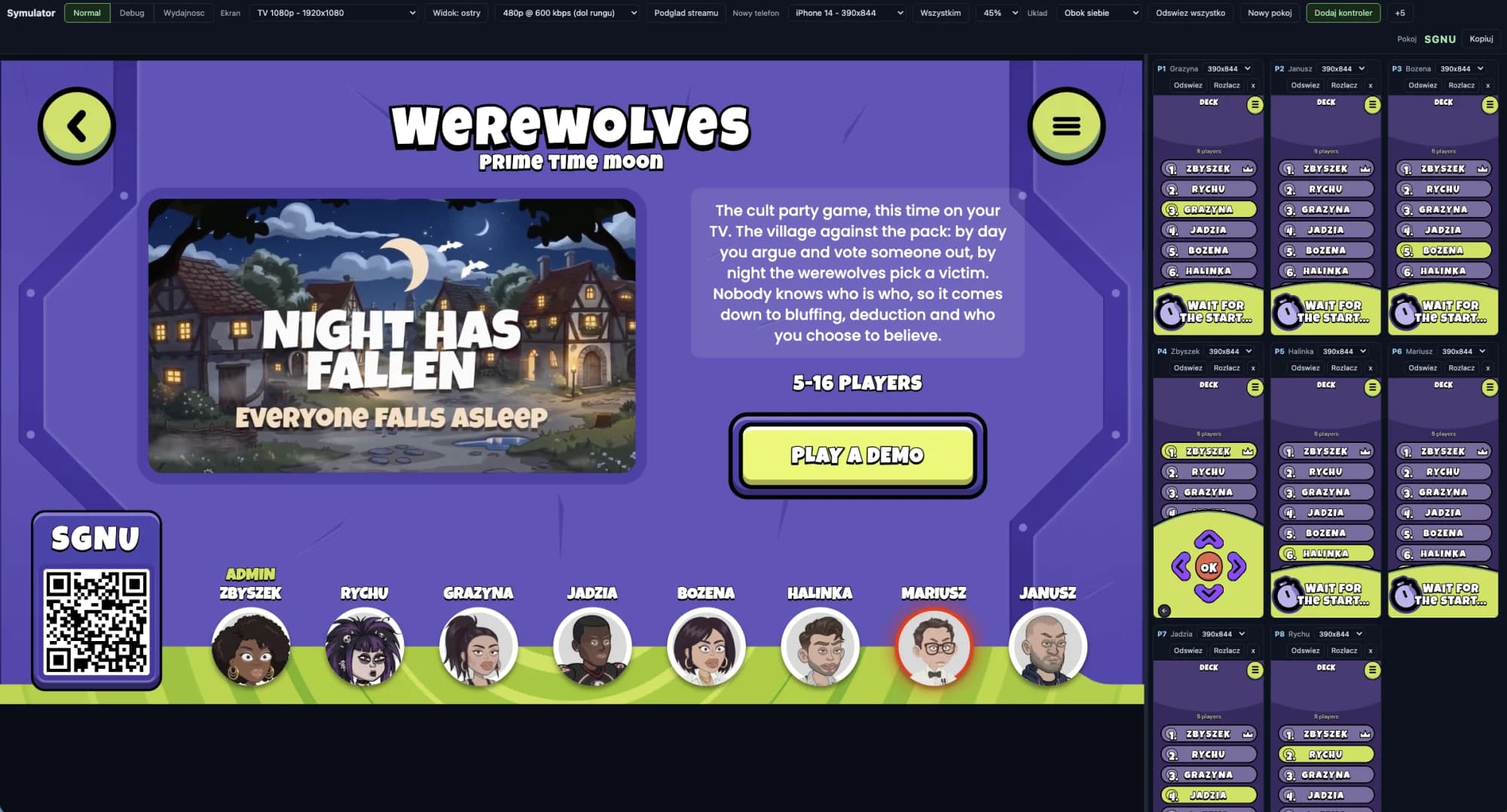
Real device presets
Controllers emulate actual phone viewports, so layout bugs surface on the size they will actually hit.
Drop and reconnect at will
Disconnect any single controller mid-round to test the reconnect path, which is the part that breaks real parties.
Debug and performance overlays
Frame timing and state inspection are built into the same harness rather than bolted on later.
Backend
The backend: one authority
Seventeen devices in one game have to agree on what just happened, while phones lock and reconnect.
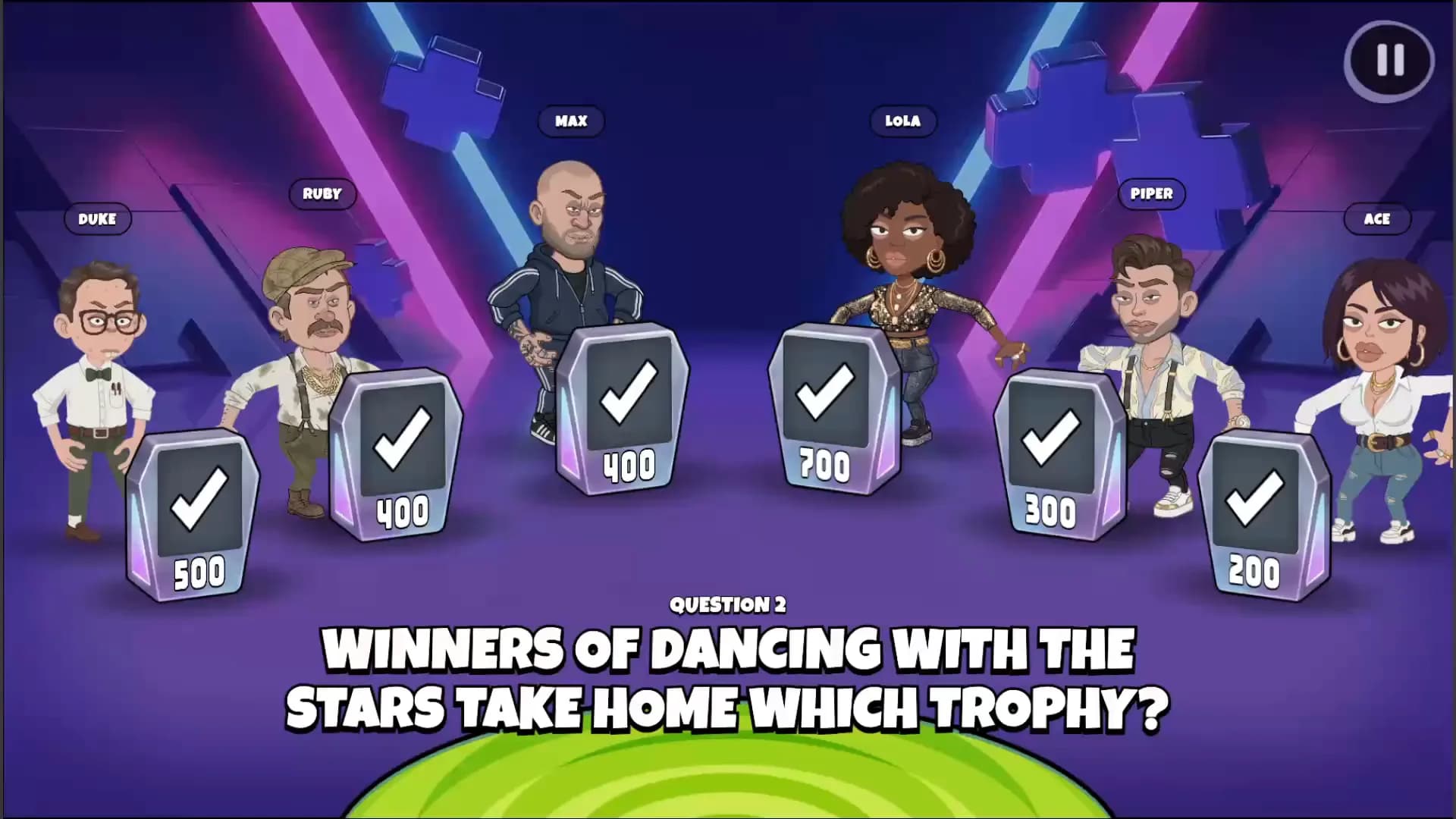
More+
The server is the single authority and clients send nothing but player actions - no client decides a score, a winner or a scene. It runs on Bun with Colyseus for authoritative rooms, PostgreSQL for content and results, and Redis for the shared state rooms need across instances. The protocol lives in one shared package imported by the server, the TV, the tools and the mobile app, so nothing is retyped by hand.
- Authority
- The server decides scores, winners and scene changes. Clients send player actions and render the state they get back.
- Stack
- Bun with Colyseus for authoritative rooms, PostgreSQL for content and results, Redis for state shared across instances.
- Protocol
- One shared contract package imported by the server, the TV, the tools and the mobile app. Zero hand-duplicated types.
- Launch
- Thousands of players arrived on day one, so room scaling and telemetry were day-one work, not a later refactor.
Content
Content tools and four languages
A quiz show is a content product, so editors needed to ship questions and voice-over without a developer.
More+
The platform ships with its own back office: a CMS for questions, decks and categories, and a visual scene editor instead of hardcoded layouts. Audio resolves through database entries rather than filename convention, so a missing voice line fails loudly in the editor rather than silently on a TV. Each market gets its own questions and its own presenter voice: the host is generated with ElevenLabs, one fixed voice per language, through a scripted pipeline rather than a folder of one-off exports. The marketing site deploys independently of the game.
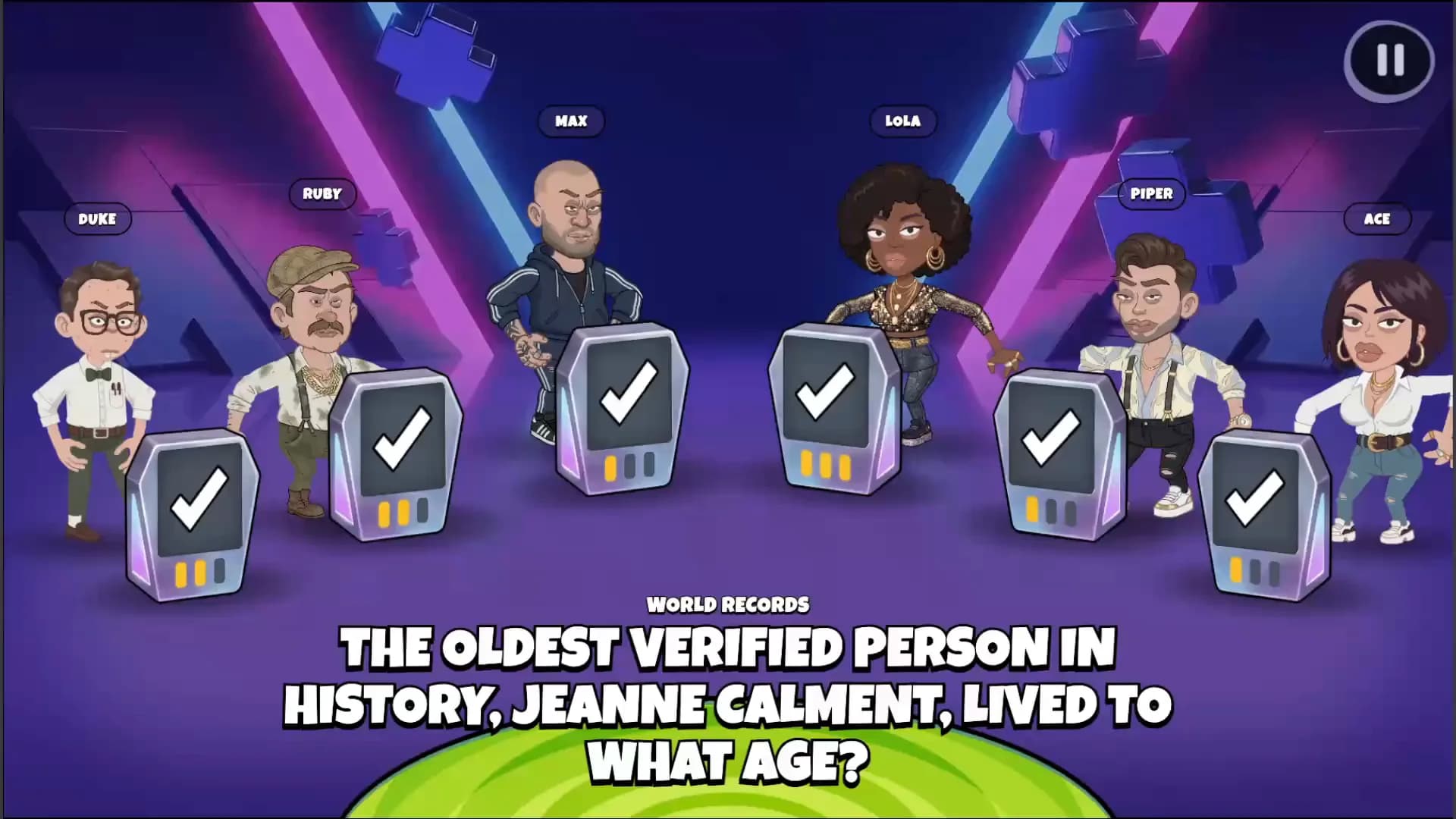
EN
English
PL
Polish
DE
German
ES
Spanish
Editors ship content, not tickets
Questions, decks and categories in a CMS, scenes built in a visual editor.
Audio is data, not a filename
Voice lines resolve through database entries, so gaps surface in the back office.
Host voice generated with ElevenLabs
One fixed voice per market, produced by a scripted pipeline so a new deck of questions gets its narration without a studio booking.
Building a multiplayer TV game - FAQ
How do you build a party game where guests do not install anything?+
The show renders in the TV browser and players join from their own phone browser with a QR code or a room code. The phone acts as a buzzer against an authoritative server, so no gamepads are paired and no guest creates an account. A native app exists for regular hosts, but it is never a requirement for the room. Compare it with other games like Jackbox.
What does a realtime multiplayer backend for a TV game need to handle?+
One TV and up to sixteen players have to agree on what happened, while phones lock, drop signal and reconnect. The server is the single authority: clients send player actions only, and every surface renders the room state it receives. Buzzin also launched to thousands of players on day one, so room scaling and telemetry were day-one work. Read what breaks with party games for large groups.
Which TVs and devices does a browser-based party game run on?+
The show runs in the browser of Samsung, Philips and LG smart TVs, on Android TV boxes, through a Chromecast, on a laptop connected over HDMI, and in any modern desktop or mobile browser. Nothing is installed on the big screen, and the same build serves every one of them. See the best party games for TV.
Can one Flutter codebase serve both a game controller and a store app?+
Yes. The controller is built as a host plus per-game plugins, the same architecture used on the TV side, with Cubits for state and code generation for models. That is what allowed a second title to ship without touching the first.
Is Buzzin a Knowledge is Power alternative?+
That is where it started. Knowledge is Power (Wiedza to Potega in Poland) proved that a TV quiz with phones as buzzers works in a living room, and then stayed locked to a PlayStation and four players. Buzzin keeps the format, drops the console, runs in any browser and takes up to sixteen players, with content authored per language instead of translated. More on games like Knowledge is Power.
How long does a platform like this take to build?+
Buzzin shipped as a full product rather than a prototype: visual design and character system, TV renderer, mobile controller, authoritative backend, CMS and scene editor, plus a localised marketing site. Scope, not headcount, moves that timeline, so the useful conversation starts with which surfaces you need on day one.
Have a realtime product in mind? Let's build it.
See it live at playbuzzin.com, then tell us which surfaces you need first.
Let's make something together.
At Codigee, we value transparency, efficiency, and simplicity. No overengineering. No wasted time.
Just straight-up execution.
We are obsessed.
Every billion-dollar company started with one decision, one step, one iteration. The key? Taking action and executing fast.