
Flutter vs. React Native Comparison: A Quick Guide for App Development in 2024
Allow me to present a Flutter and React Native comparison, tailored to your project's specific needs and interests. Let's be straightforward from the...
 By Codigee, App studio

Allow me to present a Flutter and React Native comparison, tailored to your project's specific needs and interests.
Let's be straightforward from the very beginning. Both frameworks are capable for migrating the app. Our project is a business app, not requiring any deep functionalities that either Flutter or React Native can't handle. Below is a detailed comparison which may be applied to this project:
Final outcome
Both Flutter and React Native are capable of delivering the desired end product.
Speed and Performance
The difference in speed and performance is marginal for the end user between the two frameworks.
Dependency on Extra Plugins
Flutter needs fewer 3rd party libraries and configurations, so it should be simpler and less complex in code. On the contrary, React Native relies more on third-party or community-backed libraries for aspects like UI language, icons, state management, and HTTP requests.
Development
In the Flutter and React Native comparison for app development, Flutter takes the lead with faster adaptation to WWW and simpler third-party library integration.
Team Adaptability
If no pre-existing team preferences are there, web developers usually lean towards React Native, while others may find Flutter more appealing.
Rendering Mechanism
Flutter uses Skia/Impeller for graphics rendering, while React Native employs Native Modules. This grants React Native a more "native" feel but can cause occasional compatibility issues, as opposed to Flutter's consistent rendering via its engine.
Customization
Since React Native gives a more "Native" feel there is naturally slightly less customization. Given Flutter's use of Skia/Impeller for rendering(this ensures consistent behavior across devices), it offers more customization flexibility for custom elements compared to React Native.
Popularity and Community Support
Both platforms are well-maintained communities. React Native is more mature, however, as of 2023, Flutter has gained more traction and its popularity continues to rise. The star count on GitHub reveals Flutter with 158k stars, React Native's 113k.
Deployment
Both frameworks have capabilities for CICD.
Maintenance
Flutter is easy to update thanks to built in tools, React Native is a little bit more challenging
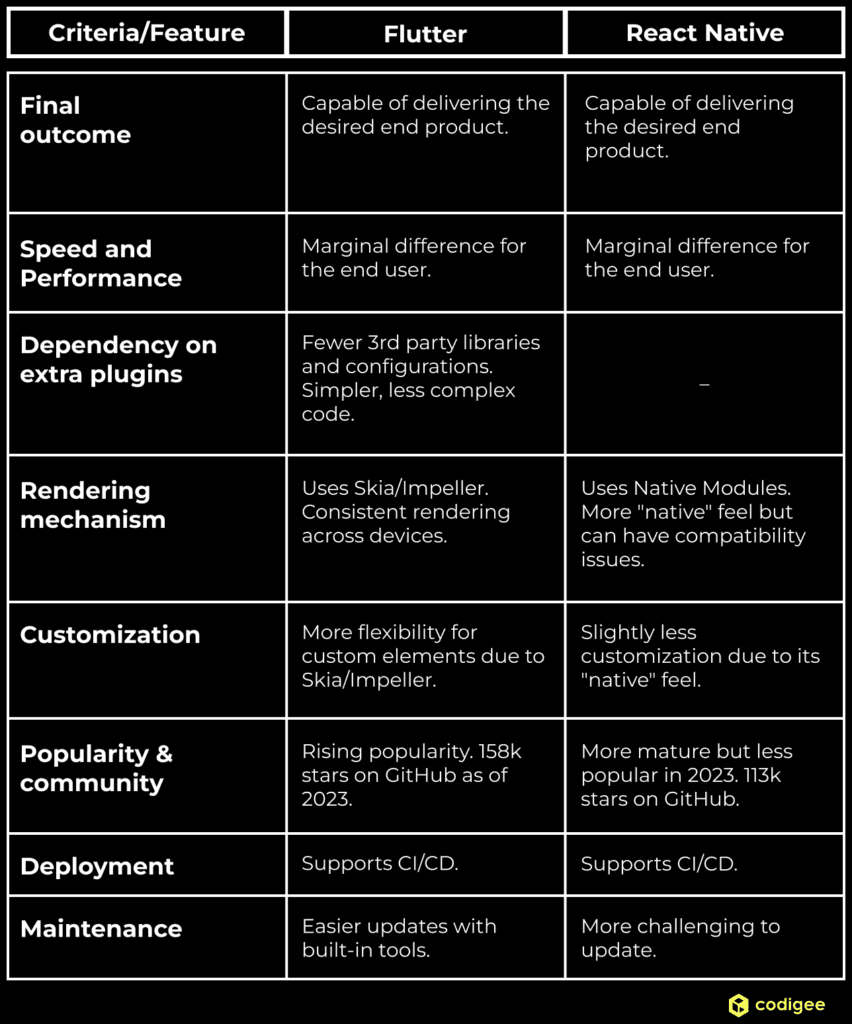
Detailed Flutter vs. React Native Comparison:
Assessing Frameworks for 2024 App Development
Summary
Both frameworks are an option. The difference in time and cost may not be significant, yet:
1. From a Business PoV Flutter may be the preferable choice due to offering a slightly simpler (and quicker) configuration.
2. Regarding the "Native" Feeling, React Native holds an advantage when it comes to delivering a better native platform experience.
3. In Terms of Customization, for projects that demand a highly customizable UI, Flutter could be the more favorable choice.
4. Maturity: When it comes market presence, React Native is more mature, but in 2023 has less popularity than Flutter.
Was this article useful?
4.7 / 5 · 7 ratings